Sock Sensors Under Scrutiny: What Wearable Foot Pressure Tech Can and Can't Tell You
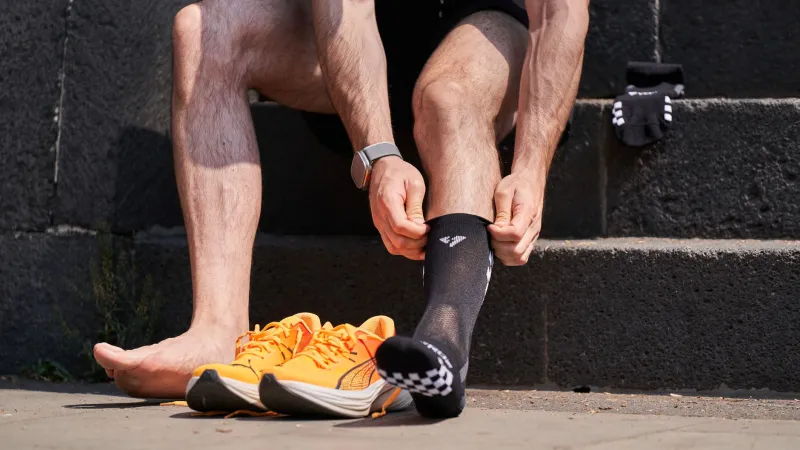
Socks that count your steps are basically a stocking filler these days. Socks that tell you how hard your second metatarsal head is loading with every stride are a different proposition altogether — and that's roughly the pitch being made to UK runners, walkers and diabetic patients in 2026.
The kit has existed in labs for years. What's changed is that it's now shoppable. You can order pressure-sensing socks from a website, pair them with your phone and get a heat map of your sole before your coffee has gone cold. The question worth asking is whether any of that is useful, or whether it's just another app to ignore.
What's actually being sold this year
There are broadly two product families. The first is textile: socks or sleeve-type garments with printed pressure sensors woven into the sole, usually paired with a small ankle-mounted transmitter and an app. The second is the sensor insole — a thin mat that sits under your existing footbed and can be moved from shoe to shoe.
Both generate similar outputs: a plantar pressure map (where you load, and how much), contact time, cadence, step-length symmetry, and some proxy for pronation. Higher-end systems add real-time feedback — a buzz when you exceed a load threshold at a specific spot.
Where the data genuinely earns its keep
Let's be fair to the tech. In three situations it does something that memory and guesswork can't.
Trend tracking. A runner with lingering forefoot pain after a half marathon block cannot reliably tell you whether they're loading differently than they were eight weeks ago. A pressure trace can. Used over months rather than minutes, that's a reasonable proxy for whether a change of shoes, a cadence nudge or a strengthening programme is having the intended effect.
Objective recall. "It only hurts in my work boots" is one of the most common things podiatrists hear, and it is often inaccurate. An in-shoe sensor worn for a shift gives a record of what actually happened on the feet, rather than what the patient remembers happening.
Load awareness in diabetes. This is the most medically serious application, and the one with the strongest evidence base. Systems that prompt the wearer to offload when pressure at a high-risk site climbs are marketed for people with loss of protective sensation. If you've got neuropathy, you may not feel the hotspot that is quietly becoming an ulcer — and anything that reliably flags it deserves a conversation with your diabetes foot team.
And where the hype creeps in
Here's the counterweight.
Consumer sensors are not lab-grade. They're thin, flexible, prone to drift, affected by sweat and temperature, and calibrated for walking on a flat surface rather than pounding a treadmill or clattering over Yorkshire setts. The numbers are useful as trends, not as absolutes — but the apps don't always present them that way.
Then there's the interpretation problem. A "pronation score" is a derived guess from pressure patterns, not a clinical assessment. High load under the first metatarsal isn't a diagnosis; it's a number that means something only alongside your history, your footwear, your training load and an examination.
And finally, the feedback loop. Some people find real-time buzzing genuinely helpful. Others find that constant load warnings make them hyper-vigilant about a foot that was, functionally, perfectly fine — which is its own kind of problem.
The money, and the NHS question
Consumer kits generally land somewhere between £150 and £350 for a pair of socks or insoles plus the transmitter and app. Some brands charge monthly for the analytics — check that before you buy, because it changes the maths considerably over two years. Medical-grade systems aimed at diabetic foot surveillance sit comfortably above that.
On the NHS: plantar pressure measurement exists in podiatry, but mostly in specialist diabetic foot services, biomechanics clinics and orthotics labs, where it informs insoles and offloading devices. Take-home wearable sensor socks are not routine NHS equipment in 2026. A few trusts run evaluations, and there is growing interest in remote monitoring for high-risk diabetic patients, but if you're hoping to be issued a pair next month, temper expectations. Ask your podiatrist what's available locally — provision genuinely varies by area.
A practical checklist before you spend
- Name the question first. "Is my forefoot loading worse than it was in March?" is answerable. "Tell me why my foot hurts" is not.
- Check the calibration story. Does the app ask for your weight and shoe size, or does it just start plotting colours?
- Look at the subscription. The upfront cost is only half the picture.
- Check shoe compatibility. Sensor insoles add volume. If your shoes are already snug, they'll change the fit — and skew what you're measuring.
- Ask whether it exports data. A clinician can do something useful with a spreadsheet. A locked heat map on a phone is much harder to work with.
- Set a review date. Three months, then decide whether it changed a decision. If it didn't, it's a gadget.
- Don't buy it instead of an assessment. Nothing here replaces an examination, and self-diagnosing from a colour gradient is a well-trodden route to the wrong pair of insoles.
- Speak to your podiatrist before buying for a medical foot. Especially with diabetes, neuropathy or any history of ulceration.
So who's it for?
If you're a data-inclined runner with a recurring niggle, or you have diabetes and a specialist team willing to look at the output with you, wearable foot pressure tech is a reasonable experiment. If you're buying it hoping an app will hand you a diagnosis, you'll be disappointed — and probably £300 lighter.
The sock knows where you pressed. It doesn't know why, and it doesn't know what to do about it. That part still belongs to a person.