The Court Doesn't Slide: Why Running Trainers Are a Bad Date for Padel
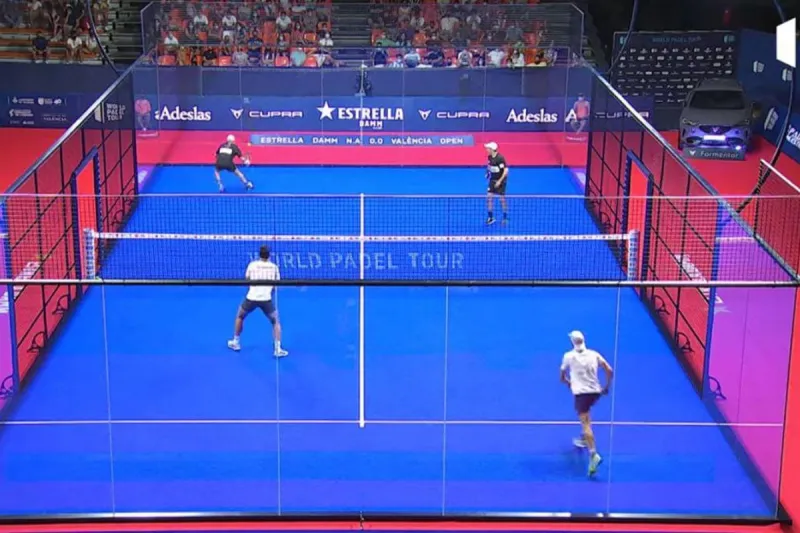
Photo: padel player close up court shoes lateral movement indoor court, via www.dmarge.com
Book a padel court on a Thursday evening in most UK cities and you'll be lucky to get a slot. The sport has spread from a handful of clubs to courts in leisure centres, converted warehouses and half the tennis clubs in the country. The kit bag has mostly kept up — racket, balls, the right grip. The shoes frequently haven't.
Walk past any padel court and count the running trainers. You'll see plenty. It's an understandable mistake: they're comfortable, they're already in the hall, and they look sporty. The problem is that a running shoe is engineered for a job padel never asks it to do.
Running is a straight-line sport. Padel isn't
A running shoe is a forward-motion machine. It has a rocker to roll you onto your toes, a generous stack of foam under the heel for landing, and a tread pattern built to grip in one direction. Every design decision assumes you're going largely forwards, repeatedly, on tarmac or track.
Padel is a sideways sport played in a box. You shuffle, split-step, pivot on the ball of your foot, push off laterally towards a wall, and stop dead to play a ball off the glass. You might cover three metres in five directions in the space of four seconds. That's a completely different set of forces, and a running shoe has almost nothing in place to manage them.
What actually goes wrong
The obvious risk is rolling an ankle, and it's the one worth taking seriously. A running shoe's upper is built to be light and breathable, not to hold your foot over a wide platform. Add a tall, soft midsole and you've created a lever: lean sideways and the shoe wants to tip before your ankle has decided anything.
Less dramatic but more common is the slow stuff. Feet sliding across the footbed inside the shoe, toes jamming into the front on a hard stop, blisters along the inside edge from a shoe that's rotating slightly with every cut. And because hard courts are unforgiving, a shoe with no real forefoot stability leaves the ball of the foot doing the work.
Then there's the tread. Running outsoles are usually designed around heel-to-toe contact. On a sand-dressed artificial turf court, or a smooth indoor acrylic surface, the wrong pattern gives you either slip or an unnerving amount of grab — enough to stop your foot while your knee keeps travelling.
What a proper padel shoe brings
Lateral support. Look for a reinforced midfoot cage, a wider base, and a heel counter that doesn't fold when you squeeze it. If you can push the upper sideways over the midsole with your thumb, it's not going to hold you in a pivot.
Pivot-friendly grip. Court shoes for racket sports typically use a herringbone or modified pivot pattern, which grips in multiple directions but still releases when you rotate. That release matters — a sole that grabs absolutely everywhere turns a rotation into a knee problem.
A lower, firmer ride. You want to feel the court. Cushioning should be there, especially under the forefoot, but a wobbly stack is a liability when you're changing direction.
Toe and inner-edge protection. Drag on the toe and the inside edge is normal in padel. Reinforced panels make the difference between a shoe that lasts a season and one that's through the upper by March.
Durability for hard surfaces. Outdoor padel courts chew through soft running foam. Court shoes use denser rubber compounds for exactly this reason.
The winter venue question
Padel in the UK splits between indoor halls and outdoor courts, and the two ask different things of your footwear.
Indoors, the surface is usually smooth and the grip is good — sometimes too good. Condensation from wet coats and shoes can make the area around the glass treacherous, so a sole that clears water rather than sitting on it helps. Keep a spare pair of socks in the bag; cold feet lose feel, and feel is what stops you rolling an ankle.
Outdoors on sand-dressed turf, the surface is slower and more forgiving but the sand gets everywhere. Cold weather makes rubber compounds harder, so a shoe that felt grippy in September can feel skittish in January. If you play outdoors through winter, warm up properly and give yourself the first two games to find your footing.
A quick footwork risk checklist
Before your next game, run through this:
- Can you slide your foot sideways inside the shoe when it's laced up? If yes, it's too wide or too loosely laced.
- Does your heel lift when you push off? Retie with a heel-lock lacing pattern before you blame the shoe.
- Can you press your thumb into the side of the midsole and feel it fold? That's a lateral collapse waiting to happen.
- Are your toes touching the front when you stand? On a court, your foot slides forward on hard stops. You need room.
- Is the outsole worn smooth along the inner edge? That's your pivot zone, and it's the first part to go.
- Have you rolled an ankle in the last six months? Then stop borrowing shoes and buy a pair built for the job.
The small stuff that helps
Wear proper sports socks rather than everyday cotton — the moisture management matters more than the cushioning. Trim your toenails before you play, because jamming a long nail into the end of a shoe on a hard stop is a special kind of regret. And replace court shoes when the tread goes, not when the upper splits; by the time a hole appears you've been playing on slicks for a month.
Running trainers are excellent at being running trainers. On a padel court they're doing a job they were never hired for — and your ankles will eventually present the invoice.